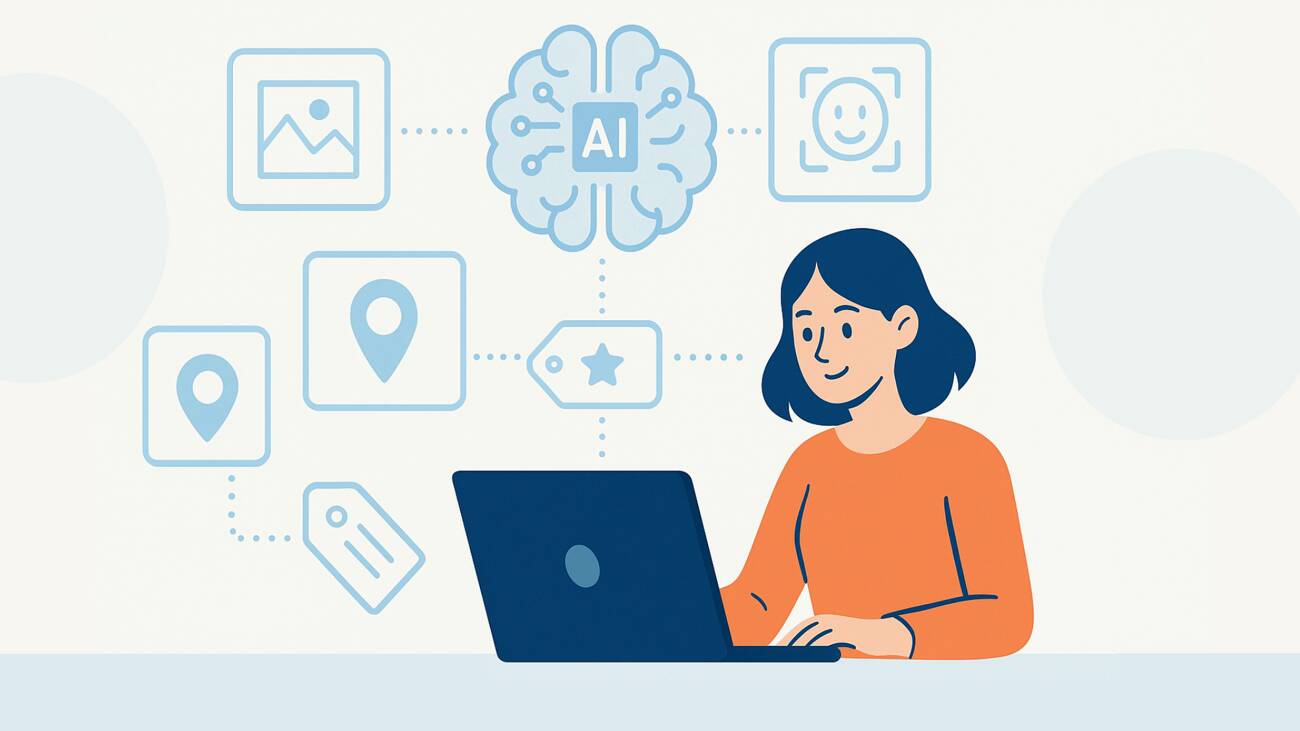
AI tagging in Digital Asset Management (DAM) refers to the use of artificial intelligence to automatically analyze and assign descriptive metadata to digital assets. Instead of relying entirely on manual tagging, AI-powered systems identify objects, scenes, text, faces, or patterns within files and generate relevant keywords automatically.
By automating metadata creation, organizations reduce manual effort while improving asset discoverability across large libraries.
AI-driven tagging uses machine learning and computer vision models to examine content inside files.
For example:
The system then suggests or assigns metadata terms, which teams can review, refine, or approve.
This process transforms raw files into searchable assets in seconds.
As digital libraries grow, manual tagging becomes slow and inconsistent. Teams often skip metadata entry entirely when deadlines are tight.
AI-assisted metadata generation helps organizations:
When implemented thoughtfully, intelligent tagging strengthens both speed and structure.
Manual tagging relies entirely on human input. While it offers contextual understanding, it can be inconsistent and time-consuming.
Automated classification:
However, the best results often come from a hybrid approach. AI generates suggested terms, and humans validate or refine them to match organizational standards.
AI-generated keywords work best when aligned with a controlled vocabulary.
When automated metadata maps to approved terminology, search results remain structured and predictable. Without governance, AI tagging can introduce variation or duplicate concepts under different labels.
Organizations that combine AI classification with standardized metadata achieve both speed and consistency.
AI-powered asset labeling is widely used in:
Any organization working with thousands of files can benefit from intelligent automation.
Daminion integrates AI-assisted tagging into its DAM platform, allowing teams to automatically classify assets while maintaining full control over metadata standards.
This approach supports faster organization without sacrificing accuracy or governance.