
Top 5 Enterprise Photo Management Software Solutions (Compared)

In today’s content-driven world, organizations rely on images to support marketing, communications, and public-facing work. To keep growing photo libraries usable, enterprise photo management software helps teams store, organize, and control visual assets for long-term use.
Without the right system, managing thousands of photos quickly becomes time-consuming. Scattered folders, duplicate files, and unclear permissions slow teams down and increase the risk of mistakes.
In this article, we explore what to look for in enterprise photo management software and compare leading solutions — including why Daminion is trusted by media teams, universities, and corporate marketing departments managing large image libraries.
At enterprise scale the honest test is your own archive, not a demo dataset — you can index a real department folder and see how search behaves before involving anyone else.
1. In large organizations, managing vast volumes of digital images can spiral into chaos.
2. Without an efficient photo management solution, teams waste time searching for assets, leading to costly delays and missed promotional opportunities, while improper access controls can create data breaches.
3. Daminion is the perfect solution for large enterprises, offering AI-driven file management features, robust security controls, and seamless integration with other industry tools (Adobe Lightroom, to streamline workflows, safeguard your image libraries, and enhance team collaboration.

Discover How Daminion Can Work for You
What is Enterprise Photo Management Software?
Enterprise Photo management software keeps your image collections organized so you don’t have to spend time searching through folders, drives and cloud storage whenever you need a particular photo. It is like having an efficient librarian by your side who can instantly find the photos you need without any stress or hustle on your side.
Photo management software is becoming increasingly popular with large organizations. According to DataHorizzons, a consultancy providing insights into market trends, the industry is projected to grow from its current value of 3.6 billion to 5.9 billion by 2032. The main drivers of this growth are the proliferation in digital photography, the use of AI in photo tagging and the growing need for team collaboration within larger organizations.
How Can the Right Photo Management Software Help Your Enterprise?
Let’s look at a few real-life scenarios where good photo management software is essential for large organizations.
- Media and Press Centers. A media center releases multiple articles daily, choosing between hundreds of images to support each breaking story. Deadlines are tight, and security is important, since the center deals with many different clients.Good photo management software ensures your images are safely stored, properly categorized and easily found.
- Universities and Educational Institutions. A university stores thousands of images recording events such as graduations and awards. But some students decide to opt out of allowing their photos to be shared in promotional material. With enterprise photo management software such as Daminion, you can use facial recognition features to find photos of those students and set specific usage permissions.
- Marketing Teams and Agencies. A corporate marketing department works on multiple projects with teams spread across many locations, so efficient collaboration and approval workflows are key to preventing frustration and missed deadlines. Robust photo management software ensures all your teams use the correct versions of branded images, automates workflows to speed up the approval process and allows integration with other creative software to easily produce beautiful marketing material.
Enterprise photo management software solves these and many more challenges for a wide spectrum of industries. New software solutions appear on the market all the time, so how do you go about choosing the tool best suited to your unique situation?
Key Enterprise Photo Management Requirements and Considerations
While individual professionals may find solutions such as Google Photos or Adobe Lightroom sufficient, larger enterprises have additional requirements which can only be met by dedicated asset management software such as Daminion:
- Centralized repository to allow all team members to access and quickly find approved images;
- Ability to scale for large collections without affecting performance;
- Ability to work with a wide range of file formats;
- Team collaboration to speed up workflows;
- Version controls to track and manage changes;
- Flexible access permissions;
- Facilities to access the collection remotely;
- Automating repetitive tasks such as image tagging;
- Faceted search, which lets you navigate hierarchical keyword structures.
These features are indispensable for enterprises that require fast and accurate access to the volume of photos generated by events and marketing campaigns. When you have thousands of images, complex copyright restrictions and large teams, it’s just not feasible to work with collections scattered across file storage systems.
Further Considerations
- AI tagging for quick file organization. If you have a large and fast-growing collection of photos, categorizing your images can become overwhelming and plain tedious. The top photo management solutions should include AI tagging and Facial Recognition, which automatically recognize objects, locations, and faces in images. This is particularly helpful for press centers managing event photos or universities handling portrait shots, saving hours of work during image import.
- Advanced Filtering options. To meet the tight deadlines of your next marketing campaign or press release, a robust file search can be a game changer. Good photo management software should offer you many different ways to search and filter your collection: by keywords, metadata, shapes and objects, colors, individual faces and more. Faceted searches allow you to drill down through a hierarchy of categories and keywords to find the images you want.
- Deployment options. Different organizations have different needs. While some businesses find it convenient to store images in the cloud, others prefer to host their collection on their own servers (on-premise) thanks to enhanced security, faster file retrieval, and lower storage costs.
- Compliance with data protection laws. If you’re handling sensitive or personal data, such as student portraits or event photos, you must ensure compliance with data protection regulations. Some jurisdictions may restrict what data can be stored remotely, and some may require explicit consent to storing personal details in the cloud. This includes Facial Recognition, which is classified as biometric data and subject to strict rules. Whether you store data on-premise or in the cloud, ensuring proper certifications and privacy protocols is essential.
Tips for Choosing the Right Photo Management Software for Your Enterprise
Everyone’s needs are different when it comes to enterprise photo management software, and you should evaluate different options to see how they best fit your goals and workflow. Most software offers a free trial, so it’s worth testing a few different packages to make sure you find the best fit. Here are some things to bear in mind as you make your choice.
- Understand Your Company’s Needs. Before you begin, outline your company’s specific requirements. Do you need advanced search capabilities? Is an on-premise or cloud-based solution right for you? Is version control essential? These and other questions help you to set priorities.
- Calculate Your Budget. Quality matters, but the most expensive option isn’t always the best. The right solution should save time, improve efficiency, and deliver long-term value. You may like to try out Daminion’s ROI calculator to find out how photo management software can affect your bottom line.
- Asses Software’s Scalability. As your business grows, so will your digital assets. Opt for software that can scale with your expanding needs, so you won’t invest in a solution that you’ll eventually outgrow. You really don’t want to be in the middle of uploading images for an important PR campaign and find you’ve reached the maximum limits of your software – or have your searches grind to a halt because your software can’t handle the increased workload. Enterprise photo management solutions such as Daminion easily handle expanding libraries by offering a choice of deployment options: cloud, on-premise and hybrid.
- Consider Your Security Requirements. In an age where data breaches are all too common, prioritize software that offers robust security features, ensuring your assets remain protected. You should give some thought to the type of security you need, both for your file storage and for data in transit when you’re sharing or collaborating with your team. If your data is very sensitive, an on-premise solution gives you more control over your security than cloud-based solutions.
- Consider User Experience. A user-friendly interface significantly reduces the learning curve, ensuring your team makes the best use of the software from day one.
- Check Integration Capabilities. The software should seamlessly integrate with your other tools and platforms. This ensures a smooth workflow and reduces potential hiccups.
Top 10 Enterprise Photo Management Software
Let’s have a look at five top-class photo management solutions designed to meet the needs of large organizations.
1. Daminion
Best all-round enterprise photo management solution.
Daminion is a digital asset management system well-suited to large enterprise requirements. It’s designed to allow you to easily manage large collections, and quickly find the exact image for every occasion. Team collaboration is a high priority, and the combination of a simple interface and excellent training resources get you up and running quickly.

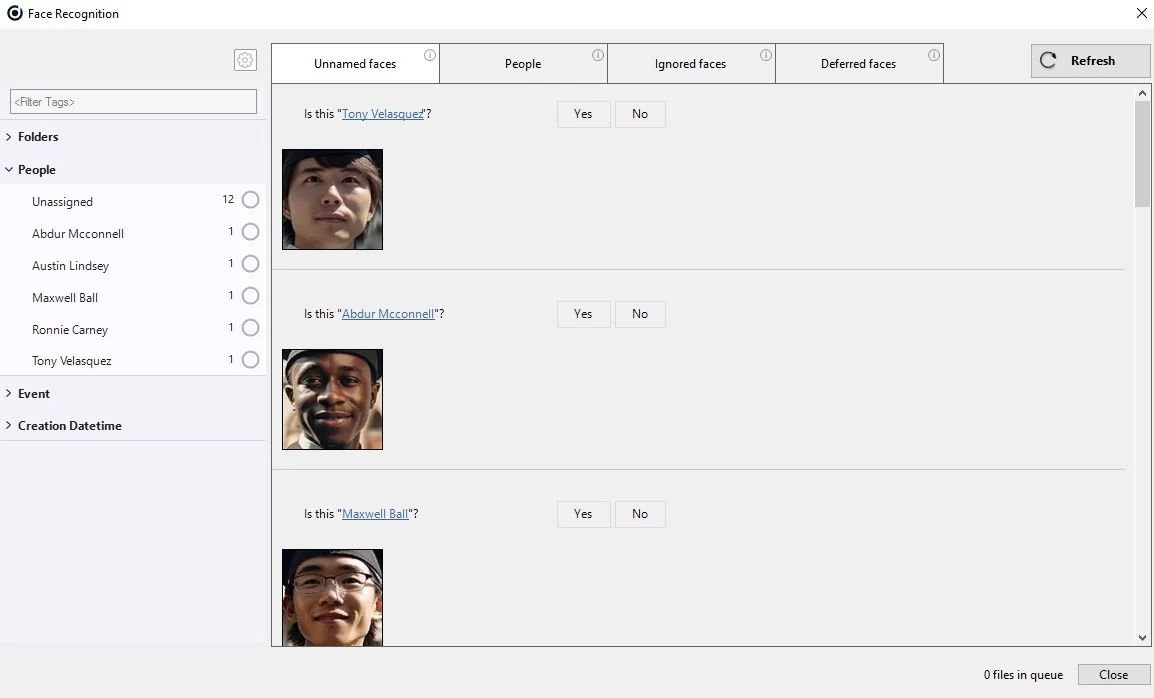
Do you spend hours uploading and organizing large collections of photos taken at events such as university graduations or company promotions? Daminion’s batch tagging, AI auto-tagging and facial recognition can achieve this for you in just a few minutes. Its advanced search facilities drastically reduce the time it takes to find the best images for your current project.
If your collection includes sensitive information, as is often the case with educational organizations or government departments, Daminion’s on-premise solution gives you greater control over your data.
No matter how large your collection grows, you’ll always be able to scale up with Daminion to accommodate it.
- Advanced tagging capabilities, including custom tags, hierarchical tags and batch tagging. Daminion uses AI auto-tagging and facial recognition to speed up the categorization process;
- Version control, allowing you to store and manage multiple versions of an image. You can also revert to an earlier version if you ever need to;
- Strict and flexible access controls;
- Good team collaboration facilities;
- Support for a wide range of file and metadata formats.
Daminion has all the important capabilities of more expensive solutions, making it an ideal choice for managing your enterprise photo collections.
Still Deciding?
Take Daminion for a Test Drive

2. Fotoware
Good for large teams if facial recognition isn’t needed
Fotoware is designed for large collections, and has good team collaboration workflows. Featuring customizable access controls, support for a wide range of file types and strong categorization and search facilities, it’s a popular choice for enterprise photo management. It includes AI auto-tagging, but does not support facial recognition.
It offers both on-premise and cloud options. It’s a little pricier than many other options such as Daminion, and the lack of facial recognition facilities may not be ideal for universities, press agents and other organizations that need to categorize photos of people.
3. Extensis Portfolio
Good for its simple interface and ease of use
Extensis Portfolio scales well for either small teams or large enterprises. In March 2026 the product was acquired by Axle AI and is now developed and supported by Portfolio DAM, LLC; on-premise deployment remains available and is the new owner’s focus (announcement).
It offers customizable tagging, combines AI auto-tagging with facial recognition, and supports a wide range of file and metadata formats. Access controls can be tailored to your needs, and built-in version control helps keep assets organized and up to date.
On the minus side, Extensis Portfolio is fairly pricey, and tends to be resource-hungry when dealing with large collections.
4. Photoshelter
Good for photographers who want to showcase their work
Photoshelter’s main strength lies in its monetization features, making it a strong option for those who want to sell digital assets. Beyond that, the platform also supports organizations managing large in-house photo collections. Thanks to robust tagging and search tools, teams can stay organized, while the system scales to handle enterprise-level volumes. Basic AI auto-tagging and facial recognition are available, along with role-based access controls.
It’s a good choice for photographers, but doesn’t have the advanced team collaboration facilities that most larger enterprises rely on.
5. Microsoft Sharepoint
Good for integration into existing Microsoft workflows
Microsoft Sharepoint is not, strictly speaking, photo management software. However, it includes an image library app, which meets the needs of many enterprises who need to categorize, share and collaborate on images.
The app allows you to include image management as part of your general document management strategy. Sharepoint has strong security and access controls, and integrates with other Microsoft products such as Office 365, Teams and OneDrive. The image app allows batch tagging and custom metadata, and it has good search facilities.
For more comprehensive photo management features such as AI auto-tagging and facial recognition, it can be interfaced via API to Azure Cognitive Services. This requires some specialist knowledge to implement.
Although Sharepoint works well for smaller image collections stored as part of the organization’s general document management strategy, organizations dealing with large photo collections may find it restrictive.
Enterprise Photo Management Software Comparison Table
The table below compares the features of the five photo management solutions discussed in the previous sections.
Daminion’s rich features, moderate price tag and choice of storage options make it a popular choice for working in an enterprise environment. It integrates with Adobe Lightroom to include photo editing in your workflow, allows you to preview a wide range of image formats, and includes advanced categorization and search facilities.
Choosing the Right Photo Organization Software for Your Enterprise
Photo management software is an essential investment if your organization has a large collection of digital images. With the right software, you can:
- Increase productivity;
- Reduce errors;
- Enhance security;
- Maintain branding integrity;
- Optimize teamwork;
- Improve confidentiality.
It’s well worth taking the time to look carefully at the solutions available and make the best choice for your team.
Daminion is a fast and efficient solution for organizing your corporate photo collection. Whether you’re a marketing executive, a media and press specialist or need to promote your educational organization, Daminion makes sure the right photos are available to the right people at the right time. It helps your team collaborate to best advantage, and keeps your collection secure.
Why not start right away by booking a demo with Daminion? You’ll see for yourself how it takes the pain away from managing your image collections and how it can increase the quality and brand consistency of your content.
If this is the direction, run it against one department’s archive first, and see the pricing page for licensing — it is per user and independent of how much you store.
Discover How Daminion Can Work for You
Enterprise Photo Management: Questions at Scale
What changes when photo management becomes “enterprise”?
Three things: the number of people who need different levels of access, the need for one vocabulary across departments that do not talk to each other, and the requirement that the archive outlive the person who built it. Tools built for one photographer solve none of these.
How does it handle several hundred users?
Access is assigned by role rather than per person, and the system authenticates against Active Directory, LDAP or SAML, so accounts are not maintained twice. Rights can go down to folder and file level, which is what makes it workable to give contractors a narrow slice of the archive.
Can we get reports on how assets are used?
Not from a built-in analytics module — reporting is on the vendor’s development list rather than something you can switch on today. If usage reporting is a requirement for your project, treat it as a gap to plan around rather than assume it is there.
Is there an approval workflow before assets are published?
Version history and locking are available, and the web client supports moderator approval of uploaded files. What does not exist is a request-and-approve basket, where users collect assets and an administrator authorises the download. If your process depends on that, it needs another route.
How do product images get into other systems?
Through the API and export presets, with integrations into the Adobe applications teams already use. The practical approach is to keep the DAM as the source of truth and push derivatives outward, rather than letting each system hold its own copy.
Can we roll this out without a migration project?
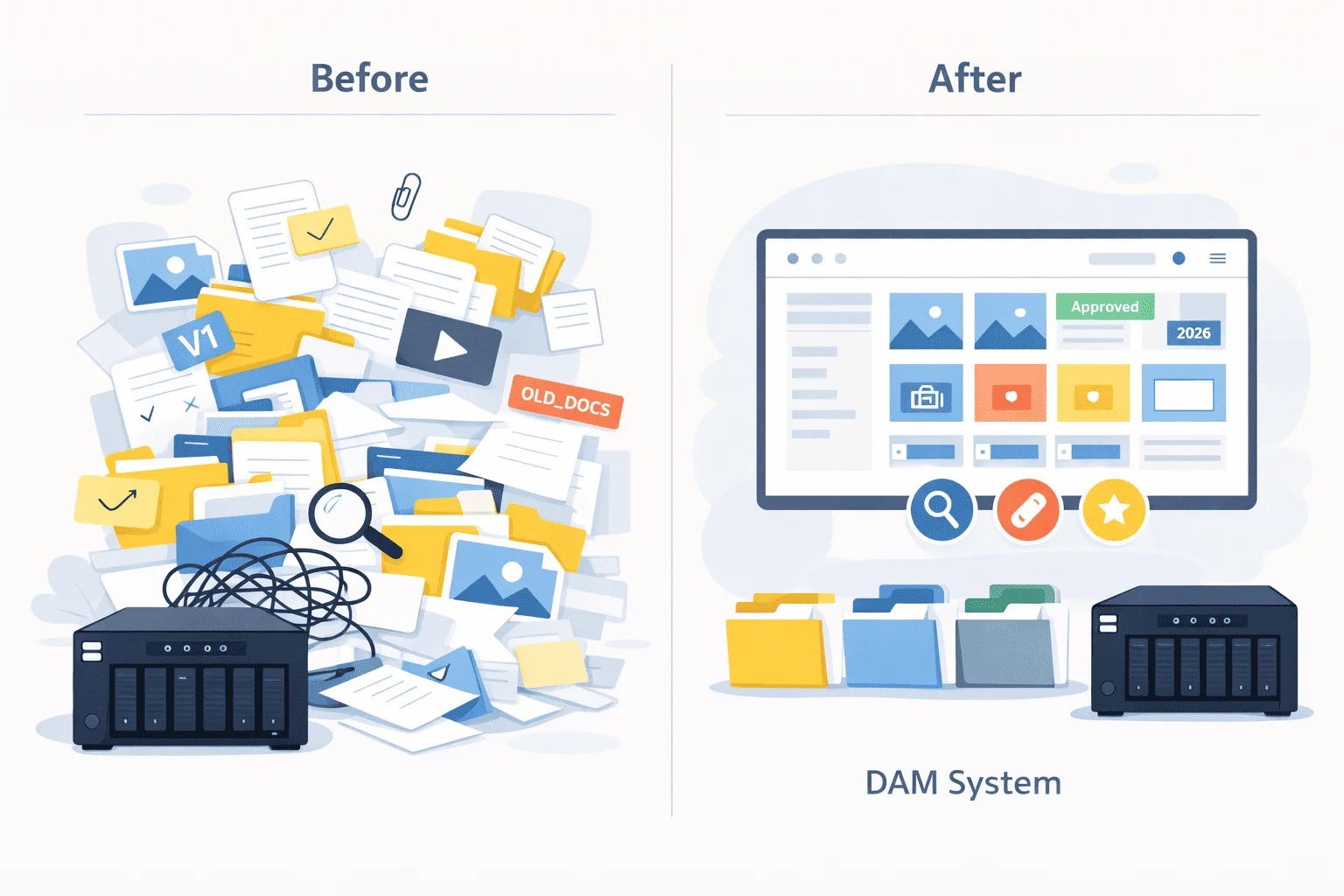
Yes, and that is usually the reason it gets approved. The archive is indexed where it already lives, folder structures are preserved, and existing IPTC and XMP metadata is read during indexing — so day one does not require moving several terabytes.



Explore our DAM system
with your personal manager
demo from your dedicated manager.